Slot Machines Reinforcement Schedules
Schedules of reinforcement can affect the results of operant conditioning, which is frequently used in everyday life such as in the classroom and in parenting. Let’s examine the common types of schedule and their applications.
Table of Contents
Schedules Of Reinforcement
Operant conditioning is the procedure of learning through association to increase or decrease voluntary behavior using reinforcement or punishment.
Schedules of reinforcement are the rules that control the timing and frequency of reinforcer delivery to increase the likelihood a target behavior will happen again, strengthen or continue.
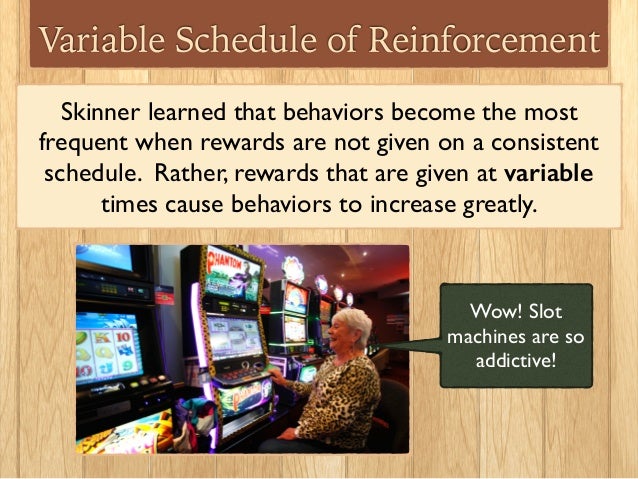
Slot machines, in particular, are of a variable ratio schedule because people will spend hours sitting there pulling the lever in hopes to score big. In operant conditioning, a variable-ratio schedule is a schedule of reinforcement where a response is reinforced after an unpredictable number of responses. Feb 04, 2020 Partial Reinforcement and Gambling. This is applicable in the case of gambling at a slot machine, and feeling unable to stop. When a person gambles at a slot machine, they’re unaware of when they will win a certain consequential amount of money, how much money and time they will need to spend to achieve that, or even if they will ever win. If the horse trainer chose to employ a variable ratio schedule of reinforcement, then, like the slot machine, the reward would come based on an average number of responses.
A schedule of reinforcement is a contingency schedule. The reinforcers are only applied when the target behavior has occurred, and therefore, the reinforcement is contingent on the desired behavior1.
There are two main categories of schedules: intermittent and non-intermittent.
Non-intermittent schedules apply reinforcement, or no reinforcement at all, after each correct response while intermittent schedules apply reinforcers after some, but not all, correct responses.
Non-intermittent Schedules of Reinforcement
Two types of non-intermittent schedules are Continuous Reinforcement Schedule and Extinction.
Continuous Reinforcement
A continuous reinforcement schedule (CRF) presents the reinforcer after every performance of the desired behavior. This schedule reinforces target behavior every single time it occurs, and is the quickest in teaching a new behavior.
Continuous Reinforcement Examples
e.g. Continuous schedules of reinforcement are often used in animal training. The trainer rewards the dog to teach it new tricks. When the dog does a new trick correctly, its behavior is reinforced every time by a treat (positive reinforcement).
e.g. A continuous schedule also works well with very young children teaching them simple behaviors such as potty training. Toddlers are given candies whenever they use the potty. Their behavior is reinforced every time they succeed and receive rewards.
Partial Schedules of Reinforcement (Intermittent)
Once a new behavior is learned, trainers often turn to another type of schedule – partial or intermittent reinforcement schedule – to strengthen the new behavior.
A partial or intermittent reinforcement schedule rewards desired behaviors occasionally, but not every single time.
Behavior intermittently reinforced by a partial schedule is usually stronger. It is more resistant to extinction (more on this later). Therefore, after a new behavior is learned using a continuous schedule, an intermittent schedule is often applied to maintain or strengthen it.
Many different types of intermittent schedules are possible. The four major types of intermittent schedules commonly used are based on two different dimensions – time elapsed (interval) or the number of responses made (ratio). Each dimension can be categorized into either fixed or variable.
The four resulting intermittent reinforcement schedules are:
- Fixed interval schedule (FI)
- Fixed ratio schedule (FR)
- Variable interval schedule (VI)
- Variable ratio schedule (VR)
Fixed Interval Schedule
Interval schedules reinforce targeted behavior after a certain amount of time has passed since the previous reinforcement.
A fixed interval schedule delivers a reward when a set amount of time has elapsed. This schedule usually trains subjects, person, animal or organism, to time the interval, slow down the response rate right after a reinforcement and then quickly increase towards the end of the interval.
A “scalloping” pattern of break-run behavior is the characteristic of this type of reinforcement schedule. The subject pauses every time after the reinforcement is delivered and then behavior occurs at a faster rate as the next reinforcement approaches2.
Fixed Interval Example
College students studying for final exams is an example of the Fixed Interval schedule.
Most universities schedule fixed interval in between final exams.
Many students whose grades depend entirely on the exam performance don’t study much at the beginning of the semester, but they cram when it’s almost exam time.
Here, studying is the targeted behavior and the exam result is the reinforcement given after the final exam at the end of the semester.
Because an exam only occurs at fixed intervals, usually at the end of a semester, many students do not pay attention to studying during the semester until the exam time comes.
Variable Interval Schedule (VI)
A variable interval schedule delivers the reinforcer after a variable amount of time interval has passed since the previous reinforcement.
This schedule usually generates a steady rate of performance due to the uncertainty about the time of the next reward and is thought to be habit-forming3.
Variable Interval Example
Students whose grades depend on the performance of pop quizzes throughout the semester study regularly instead of cramming at the end.
Students know the teacher will give pop quizzes throughout the year, but they cannot determine when it occurs.
Without knowing the specific schedule, the student studies regularly throughout the entire time instead of postponing studying until the last minute.
Variable interval schedules are more effective than fixed interval schedules of reinforcement in teaching and reinforcing behavior that needs to be performed at a steady rate4.
Fixed Ratio Schedule (FR)
A fixed ratio schedule delivers reinforcement after a certain number of responses are delivered.
Fixed ratio schedules produce high rates of response until a reward is received, which is then followed by a pause in the behavior.
Fixed Ratio Example
A toymaker produces toys and the store only buys toys in batches of 5. When the maker produces toys at a high rate, he makes more money.
In this case, toys are only required when all five have been made. The toy-making is rewarded and reinforced when five are delivered.
People who follow such a fixed ratio schedule usually take a break after they are rewarded and then the cycle of fast-production begins again.
Variable Ratio Schedule (VR)
Variable ratio schedules deliver reinforcement after a variable number of responses are made.
This schedule produces high and steady response rates.
Variable Ratio Example
Gambling at a slot machine or lottery games is a classic example of a variable ratio reinforcement schedule5.
Gambling rewards unpredictably. Each winning requires a different number of lever pulls. Gamblers keep pulling the lever many times in hopes of winning. Therefore, for some people, gambling is not only habit-forming but is also very addictive and hard to stop6.
Extinction
An extinction schedule (Ext) is a special type of non-intermittent reinforcement schedule, in which the reinforcer is discontinued leading to a progressive decline in the occurrence of the previously reinforced response.
How fast complete extinction happens depends partially on the reinforcement schedules used in the initial learning process.
Among the different types of reinforcement schedules, the variable-ratio schedule (VR) is the most resistant to extinction whereas the continuous schedule is the least7.
Schedules of Reinforcement in Parenting
Many parents use various types of reinforcement to teach new behavior, strengthen desired behavior or reduce undesired behavior.
A continuous schedule of reinforcement is often the best in teaching a new behavior. Once the response has been learned, intermittent reinforcement can be used to strengthen the learning.
Reinforcement Schedules Example
Let’s go back to the potty-training example.
When parents first introduce the concept of potty training, they may give the toddler a candy whenever they use the potty successfully. That is a continuous schedule.
After the child has been using the potty consistently for a few days, the parents would transition to only reward the behavior intermittently using variable reinforcement schedules.
Sometimes, parents may unknowingly reinforce undesired behavior.
Because such reinforcement is unintended, it is often delivered inconsistently. The inconsistency serves as a type of variable reinforcement schedule, leading to a learned behavior that is hard to stop even after the parents have stopped applying the reinforcement.
Variable Ratio Example in Parenting
Concrete Reinforcement Schedules
When a toddler throws a tantrum in the store, parents usually refuse to give in. But once in a while, if they’re tired or in a hurry, they may decide to buy the candy, believing they will do it just that one time.
But from the child’s perspective, such concession is a reinforcer that encourages tantrum-throwing. Because the reinforcement (candy buying) is delivered at a variable schedule, the toddler ends up throwing fit regularly for the next give-in.
This is one reason why consistency is important in disciplining children.
Related: Discipline And Punishment
References
- Case DA, Fantino E. THE DELAY-REDUCTION HYPOTHESIS OF CONDITIONED REINFORCEMENT AND PUNISHMENT: OBSERVING BEHAVIOR. Journal of the Experimental Analysis of Behavior. Published online January 1981:93-108. doi:10.1901/jeab.1981.35-93
- Dews PB. Studies on responding under fixed-interval schedules of reinforcement: II. The scalloped pattern of the cumulative record. J Exp Anal Behav. Published online January 1978:67-75. doi:10.1901/jeab.1978.29-67
- DeRusso AL. Instrumental uncertainty as a determinant of behavior under interval schedules of reinforcement. Front Integr Neurosci. Published online 2010. doi:10.3389/fnint.2010.00017
- Schoenfeld W, Cumming W, Hearst E. ON THE CLASSIFICATION OF REINFORCEMENT SCHEDULES. Proc Natl Acad Sci U S A. 1956;42(8):563-570. https://www.ncbi.nlm.nih.gov/pubmed/16589906
- Dixon MR, Hayes LJ, Aban IB. Examining the Roles of Rule Following, Reinforcement, and Preexperimental Histories on Risk-Taking Behavior. Psychol Rec. Published online October 2000:687-704. doi:10.1007/bf03395378
- Redish AD, Jensen S, Johnson A, Kurth-Nelson Z. Reconciling reinforcement learning models with behavioral extinction and renewal: Implications for addiction, relapse, and problem gambling. Psychological Review. Published online July 2007:784-805. doi:10.1037/0033-295x.114.3.784
- Azrin NH, Lindsley OR. The reinforcement of cooperation between children. The Journal of Abnormal and Social Psychology. Published online 1956:100-102. doi:10.1037/h0042490
Schedules of Reinforcement
Reinforcement, positive or negative, needs to be properly scheduled. Schedules of reinforcement determine when reinforcers are applied. Psychologists have identified several different schedules of reinforcement. When reinforcement is administered uninterruptedly, it is called continuous reinforcement. Instead, in organizations, reinforcers are administered following partial reinforcement schedules. Four varieties of partial reinforcement schedules have great relevance to organizations. They are